Search

Friday, July 28, 2023

Windham mourns loss of business leader, community champion Bartlett

By Ed Pierce

George H. Bartlett Jr. will be remembered as a kind individual who uplifted his community and a reliable friend who wanted little praise for his volunteer efforts on behalf of others.

Longtime Lakes Region resident and Busy
Bee Laundromat owner George Bartlett Jr.
has died at the age of 84. Through the years
Bartlett has been a fixture at charitable
events locally and was an active member
of the Sebago Lake Rotary Club and the
Sebago Lakes region Chamber of Commerce.
COURTESY PHOTO
Bartlett, 84, died Friday, July 21 after a short illness. He owned and operated the Busy Bee Laundromat in Windham for 38 years and was heavily involved in the activities of the Sebago Lakes Region Chamber of Commerce and the Sebago Lake Rotary Club.

Since the 1990s, he also served as an international ambassador for the Rotary Club, making numerous trips to Romania representing Maine and making treasured friendships with Romanians.

Other than his trips to Romania, Bartlett lived for most of his life in the Windham, Raymond, and Casco areas. His mother, Olive Sawyer Morrill of Westbrook married his father, George H. Bartlett Sr. in the 1930s and the couple moved to the Little Sebago Lake area of Windham where they started a family. George Jr. was born in 1939 and his father owned the Bartlett Radio Company.

Mechanics

While helping at his father’s business after school, young George developed an interest in mechanics, and he went on to become a mechanical engineer and have a business of his own launching Busy Bee Laundromat in 1985.

“My father was in business for many years, and he gave me some great advice,” Bartlett said during an interview in 2020. “He told me that a business goes through ups and downs and the best way to keep a business going is to serve the people,” Bartlett said. “That’s exactly what we do here.”

According to Robin Mullins, the President and CEO of the Sebago Lakes Region Chamber of Commerce, Bartlett was well-liked by nearly everyone he met.

“One thing was his outgoing personality. He said hi and spoke to everyone he met,” she said. “He also had an infectious smile. You couldn't help but smile with him, even if you were having a bad day.”

Mullins said that Bartlett was a member and huge supporter of the Sebago Lakes Region Chamber of Commerce for years.

“The two things that stand out the most for me were first, he hosted many of the chamber’s After Hour events, or what we call Business Breaks,” she said. “During the Business Breaks we have 50/50 raffles for local charities. George would offer to squeeze himself into a dryer at the laundromat if folks gave extra dollars to the charities. We made lots of extra money for charity because of this. Second, George was a Rotarian who came to me and asked what I thought would be a great local charity to benefit from the Polar Dip, which was part of the Sebago Lake Rotary Club's Annual Ice Fishing Derby. I, of course, recommended the chamber's charitable trust, ‘Feed The Need.’ We started the Sebago Lakes Region Polar Dip for Feed the Need in 2021 and have raised over $22,000 for the 12 food pantries in the Sebago Lakes Region thanks to George.”

Huge loss

His loss will be huge to the chamber, Mullins said.

“George was my partner on the Polar Dip. I relied on him for so many things,” she said. “I have already asked myself, ‘Will I be able to do this without him?’ The answer is yes, but it will not be easy. I have to keep it going because that is what George would have wanted. The 2024 Sebago Lakes Region Polar Dip will be dedicated to my Polar Dip partner and my friend, George Bartlett.”

In years to come, Bartlett will be remembered fondly, Mullins said.

“George will be remembered for three things – his love and dedication for the Sebago Lake Rotary Club. He truly believed in the work of the Rotary and traveled to Romania several times to partner internationally. He will also be remembered for his never-ending supply of energy. George was a worker and he never stopped. I often referred to him as the ‘Energizer Bunny.’ And lastly, George will be remembered for his ability to give you a hard time and do it in a fun, jovial manner.”

Cyndy Bell of the Sebago Lake Rotary Club says Bartlett joined the club in 1985 and has been part of the fabric that has kept the club relevant and a constant in the community ever since.

“He just had a passion for the organization,” Bell said. “One event that brought him a great deal of joy and pride were his trips to Romania. In 1998 as part of a Rotary International project to meet medical needs for Romanian hospitals, the Sebago Lake Rotary Club collaborated with six other Rotary Clubs and began gathering medical equipment, collecting over $750,000 worth of equipment that included 12 refurbished dialysis machines from the Maine Dialysis Center. He traveled back to Romania to coordinate the distribution of the equipment and over the past 20 years he has returned 16 times, working with their schools, bringing books and supplies collected by Rotary clubs in Southern Maine including his local club and helping schools establish Interact Clubs, a high school version of the Rotary Club. While there, he stayed with his adopted Rotary family, making long-distance, long-term friendships.”

Outgoing personality

Bell said Bartlett’s outgoing personality was contagious and he was passionate about anything he was involved in.

“He always showed an interest in you and what you were doing or your business. And he always invited you to a Rotary meeting and encouraged you to join,” she said. “George was involved in everything that the Rotary Club was hosting. He especially was very involved in preparations for the Polar Dip held during the club's signature Ice Fishing Derby fundraiser every February. Even when things weren't going smoothly, he always had a positive attitude and made the event a success. George's presence will be missed in every event the club sponsors moving forward. He always had an ‘idea’ how to make events better.”

Funeral services are pending, and Bartlett is survived by his wife, Jane, three children and other family.

Mullins said she believes Bartlett’s legacy will be one of unselfish service to his community and a responsibility to help his friends and neighbors.

“George did what he did because that was just how he was wired,” she said. “It was who he was, a concerned community leader who wanted to make a difference. And, boy, did he ever.” <

Animal Control officer explores solution to stray pet problem

By Kaysa Jalbert

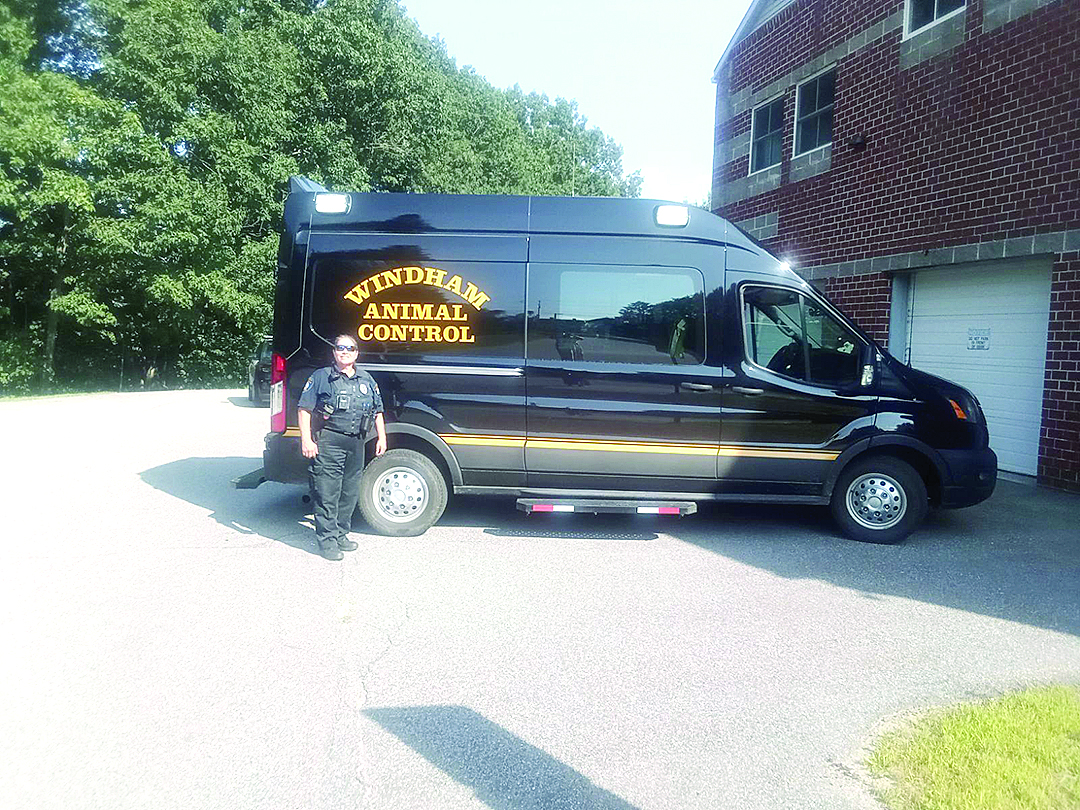
From surrendered dogs to stray cats, a small skunk in the yard or a large cow needing a new home, the animal control officer of Windham, Jackie Frye, dedicates every day to serving and protecting pets and wildlife in the area.

Jackie Frye has served as the Animal Control Officer for
Windham for more than five years and says that this year she
is busier than ever rounding up stray pets and animals
and taking them to the Animal Refuge League of Greater
Portland in Westbrook. SUBMITTED PHOTO   
“Oftentimes I am the busiest on the force with all the calls I get to relocate or find new homes for animals every day,” says Frye.

Whether it’s small pets or larger farm animals, Frye saves countless species of animals from dissimilar situations as shelters across the nation are experiencing larger numbers of animal admissions and fewer adoptions.

She contracts with the Animal Refuge League of Greater Portland out of Westbrook but has had to take matters into her own hands when it comes to giving many of these orphaned animals a new home due to lack of space in the shelters.

“People like Jackie really think outside of the box to try to find solutions and really work with people and see the good in people,” said John Florida from the Animal Refuge League of Greater Portland.

Many of the factors that impact animal welfare are financial, from overall financial instability within the market, to reduced housing options as well as breed and pet restrictions by landlords.

The Covid-19 pandemic also plays a large role in the increased need for animal shelter and rescue as many families adopted at the start of the pandemic, not knowing how long they’d be isolated at home. Once the Covid restrictions were lifted and people returned to work, the animals had to adjust and cope with not having a human around all day.

“Some animals weren’t able to cope, some humans weren’t able to cope,” says Florida.

In 2022, 136 animals from Windham families were admitted to the Animal Refuge League of Greater Portland. There have been 61 animal admissions from Windham families in 2023 thus far.

As for strays, in 2022 the Animal Refuge League had 84 from Windham, 35 were brought in by the Windham Police Department. So far in 2023, Windham Police have brought in 50 strays. These numbers only include small animals such as cats, dogs, mice, rats, guinea pigs, rabbits, and hamsters.

“People are unable to afford their animals when it comes down to taking care of the animal or giving food to themselves or their kids,” Frye said.

Cats and other domestic animals can be placed into new homes but what’s most difficult is finding a new home for larger farm animals. During the fall season many owners find it difficult to relocate these animals and feed them, resulting in unfortunate situations of animals being starved.

“Hence why I have a large animal sanctuary called Open Arms Animal Rescue and Sanctuary,” said Frye, “I started it seven years ago for that reason.”

Open Arms Animal Rescue and Sanctuary, located in Bridgton, is the direct result of Jackie recognizing an issue, and taking action.

“I can place cats and dogs, but it’s harder to try to find a place to hold a large animal. I have had quite a few animals come through: a cow named Lola, a donkey, a mini horse, three goats, five pigs, three dogs, three cats, a rabbit, some rescue chickens, and a couple roosters,” Frye said.

Those are all rescues that she took in from friends and people she knew who couldn’t take care of them anymore. Some of the animals were only supposed to stay in the sanctuary for a short period of time, but two years later, many are still there.

“People like Jackie, sanctuaries and rescues are really important to make sure everyone is getting help somewhere,” said Florida.

In addition, at home she cares for three dogs, three cats, a rabbit and “a pot belly pig that thinks she’s a dog and she goes in and out,” says Frye. “Her name is Babies.”

Frye has been the Animal Control Officer for Windham for five years as of June this year but has worked in the profession of Animal Control for a total of 10 years.

In the past, Frye covered seven towns at once, including Bridgton, Denmark, Sweden, Sebago, and Hiram. She says she is much busier in Windham than ever before.

“What I say to everyone struggling right now, just don’t give up hope. Keep hope,” says Frye.

She stressed the need for pet owners to be able to afford veterinarian care and the feed and that’s why its urgent to consider the long-term consequences for both you and your furry friend before adopting them into your home. <

Friday, July 21, 2023

Beekeeping builds buzz across Lakes Region

By R.D. Frum

Looking to embark on a buzzworthy adventure? Look no further than beekeeping: the sweetest form of multitasking. Not only does one get to produce liquid gold, but one also gets to become the ultimate wingperson for Mother Nature. Local beekeepers Isabel Kelley and Mark Cooper of Windham unveil the secrets behind the captivating world of nurturing bees.

Beekeeping is a year-round activity in the Lakes Region and
some beekeepers and farmers in Windham and Raymond
choose to sell or gift the honey that they collect from the hives
they tend. COURTESY PHOTO 
The only bees that get kept for honey production are honeybees, scientifically named Apis Mellifera. Honeybees are of Italian and Mediterranean origin, and they are the only type of bee that produce surplus amounts of honey.

Contrastingly, bumblebees are native pollinators, meaning they pollinate plants, and they may collect a small amount of nectar. But bumblebee colonies are not managed, they survive in the wild and their natural nests are typically very small with a maximum of 10 or 20 bees, or a large colony might be 100 bees. On the other hand, a honeybee hive at peak season can have 20,000 to 50,000 bees.

“You do mark the queen and if you buy a package of bees to install in a hive, the queen will usually come separated and marked with a dot on her abdomen,” Kelley says.

Honeybees are very docile and easy to work with and typically, to manage, Cooper says.

“Bumblebees are fun if you leave them alone but there’s no way to manage them,” he said. “They don’t live in hives and won’t live in manageable conditions.”

Cooper has around 100 hives on his farm Cooper Charolais Farm & Apiary in Windham.

Mites are the biggest challenger of honeybees because the bees have no way to defend themselves against the mites and the viruses and diseases they carry. Varroa mites are the most significant threat to honeybees. The immune systems of the bees are weakened as a result of the hemolymph, bee blood, that these parasitic mites feed on while attaching themselves to adult bees and their offspring. If left uncontrolled, varroa mites can spread illnesses and viruses and cause colony decline and loss.

The natural lifespan of an average honeybee is around six weeks from the time they emerge from a cell as a fully-grown adult bee. The colony can survive the chilly months thanks to the bees that start raising new baby bees known as winter bees. The winter bees emerge as autumn approaches and have a longer life span. They protect the hive and have different responsibilities and don’t forage every day, which helps to extend their life.

Bees don't hibernate throughout the winter; instead, they gather in a close-knit cluster to keep warm and gorge on honey reserves. They start brood rearing in the middle of winter to increase their population and get ready for the spring's honey and nectar flows. The hive, which is made of three-quarter-inch hardwood boards and frames, is subjected to a variety of protective methods to conserve warmth, from insulating wrapping to tar paper coverings, helping the colony's management of temperature and survival.

“I do wrap my bees up in the winter and I'll also put guards around all the entrances so that no mice can get in there,” Kelley says.

Insulating material is stapled on to lessen wind impact, while insulation sleeves and specially made plastic form a barrier around the hive to maintain temperature without obstructing bee movement. A further alternative for coping with severe weather is polystyrene insulation, which can be found in the shape of sleeves or attached panels. This enables bees to endure the elements more easily.

In the art of beekeeping, a smoker is used which suppresses the bees' natural pheromones, which are essential for communication inside the hive. The colony can continue working unhindered since this smoke calms the bees and stops the distribution of alarm pheromones. Beekeepers typically cover their faces with a mesh veil and handle frames and bees with gloves designed of thin leather specially made for beekeeping.

“Some people wear gloves all the time, some people will occasionally, and some beekeepers never wear them,” Cooper says.

“The bees go through the process of capping the honey frames, so you'll know when they're ready. They're quite heavy; they'll have a fresh coat of wax on them that's little whitish,” Kelley says. “I usually wait like many beekeepers till the end of summer, early fall to make sure that they have done as much as they can before things get too cold and they’re not out there harvesting as much.”

Beekeeping can be a costly pursuit. “For somebody starting out brand new, a complete hive we call a Langstroth hive, which is the most common commercially made hive set up in the world basically is roughly $250 for a basic setup,” Cooper says.

“The beekeeper also needs things like a smoker, hive tool and some kind of personal protective gear such as a veil, some gloves, just for protection and comfort while working with the bees,” Cooper says. “So reality is probably $500 to $1,000 expenditure for somebody getting started out is in the ballpark.”

Beekeepers decide whether they choose to sell or to gift their honey.

“We do sell honey,” Cooper says. “We sell it at the farm year-round. A typical one-pound jar of honey is around $10 and that’s probably a pretty common thing for local raw pure honey.”

Kelley said she sold the honey that she had in 2020 but that I hadn't sold it since.

“I was doing $20 for a pint mason jar and mostly it's just some neighbors that were buying it from me,” Kelley says. “But I don't typically sell it. I just kind of hang on to it and give it away as gifts for family or friends who are looking for some.” <

Raymond family’s food pantry makes a difference in community

By Kaysa Jalbert

RAYMOND – Every Tuesday morning Sabrina Golabiewski of Raymond takes a drive to the stores that have contracts with The Vineyard of Mechanic Falls Church to pick up fresh-rescue food items. Golabiewski then brings the items home, boxes them up, sends out a mass text to the community, and opens up her home for families to pick up these items anytime from noon to 7 p.m. the same day.

Sabrina Golabiewski of Raymond and her
family pick up fresh-rescue food items at
stores in the Lakes Region and then bring
the items to their home every week for
anyone in need in the community.
SUBMITTED PHOTO
Over the past five years, Sabrina Golabiewski has devoted her time and freezer space managing a food pantry from her own home as an extension of her church to make resources more widely available for families in her community.

“I started picking up fresh rescues for my church and because I have five kids, they said I could help myself to extras. When I got there, I was so overwhelmed by the amount of food that could potentially be thrown out,” said Golabiewski.

From what started as a small gesture of picking up extras for her friends and storing them in her single freezer space, the concept has expanded to providing items for between 11 to 26 families a week and they now have five freezers, some coming as donations from her community and church.

Most local food pantries have a small window of about two hours once to twice a month for families to pick up,” Golabiewski said. “I cater more to the working families so they can pick up after work.”

The most common items they collect from Golabiewski are baked goods, and lots of them. They also frequently receive produce, deli meats and some pre-made sandwiches, all not up to shopping standards to be sold, but too good to go to waste.

But she doesn’t do it all alone.

Her youngest son, Caden, 9, goes to the stores and helps pick up food with his mother. When they arrive home, the remaining four children, Cameryn, 10, Ethan, 14, Ashten, 16, Greyson, 18, all jump in to help haul the goods into the house.

There is one more team member that influenced Sabrina to have a giving heart, her mother, Connie, age 71.

“She just has a service heart,” says Golabiewski, “I definitely saw how much it meant for her to do things for others so even as a salty teenager I was happy to do these things.”

On Tuesday mornings, the family takes over the kitchen and dining room, and with food items spread out to be organized, Connie counts to make sure there’s enough boxes. Everything is then kept cool in an air-conditioned bedroom for people to come in and get their box.

To make sure nothing goes to waste, Sabrina also sends out a Facebook post so that those not in the mass texts can also have a chance at some support.

Sabrina hopes that her actions will influence her children to carry on helping their community as they grow up, just in the same way Sabrina’s mother influenced her.

“As a single mom, it’s important for my kids to see how fortunate and how blessed we are,” she said.

In addition, Golabiewski runs the 302 Nutrition shop in Raymond. This summer, a friend helps cover Sabrina’s shifts on Tuesdays while she manages the food pantry. In the fall and winter, they shut down the shop on those days to run the food pantry instead.

“Feeding the families is far more important than being open for a couple hours on a Tuesday,” said Golabiewski.

When she started at 302 Nutrition, she thought it would be a great way to give back to her community and to use the store as another way to do food drives.

In the five years that Golabiewski has been running this service for those in need, they have only missed about four to five days in total but otherwise are open every Tuesday.

“If it comes down to heating your home or eating, I don’t want to make people have to choose that,” she said. <

Friday, July 14, 2023

Internship paves way to future success for Windham graduate

By Masha Yurkevich

Most of us remember our first few jobs quite well. For Greta Paulding, one of those first jobs is working for the Town of Windham as a Marketing Intern. The 2023 WHS graduate has been interested in infrastructure reform and town planning for years and at the end of her junior year of high school, she asked RSU 14’s Director of Community Connections, Lorraine Glowczak, if she could help her find a summer job.

Greta Paulding is a marketing intern for the Town of Windham
and was recently offered an internship at U.S. Senator Angus
King's office in Washington, D.C. as a result of her graphic
designs for the Windham Wastewater Treatment site's
groundbreaking event. PHOTO BY MASHA YURKEVICH 
“I mentioned the best scenario for me would be working for the town, but I was certain that wasn’t going to happen,” said Paulding. “Within a week, she came back and said, ‘I’m still figuring things out, but I think I got you a job at the town.’ I was amazed.” She designed an Extended Learning Opportunity for me which allowed me to get school credit through a civil engineering internship. I am the first high school student to work for the town as part of the Windham Economic Development Corporation.”

Each day, Paulding sits down at her desk with a cup of tea and designs something new for the town, from creating logos, maps, and signage, to finding unique and eye-catching ways to provide valuable information to the public.

Paulding first developed an interest in civil engineering and town design three years ago when a research rabbit hole led her to a YouTube channel called “Not Just Bikes” that documented the differences between North American and European cities. “Not Just Bikes” contrasted the benefits of modern European infrastructure with the problems U.S. cities face; many of which she recognized in Windham.

“As I dove deeper, I wanted to find ways to serve my community by advocating for change. Of course, since I now work in marketing, a major part of my job is graphic design,” said Paulding. “I’ve loved art since I could hold a crayon, and it has been an important part of my upbringing. My mother is an excellent graphic designer and she taught me everything she knows. I’m so grateful to have a job that allows me to participate in improving my community through both infrastructure and infographics.”

Within her first month of work, she was assigned to search for septic documents in the town records.

“I spent three months at a desk sorting through papers that were often more than twice my age,” said Paulding.

Though she was originally prepared for a difficult and dull experience, she said that she became invested in the stories she uncovered, told through permits and plans and the occasional letter of complaint.

“I got to know my town in ways I never imagined,” she said.

Not every assignment is a glamorous one. Often, Paulding can spend an entire day looking through papers and barely making noticeable progress. However, by finding ways to enjoy her work, she never gets too discouraged.

“Sorting through files helped me learn how to find fun in every situation,” she said. “When I finally finished, I had collected data for 115 properties in North Windham and helped create a valuable resource for the engineers making the North Windham sewer system a reality.”

As she did more design work for the town, she realized that marketing was a better fit for her than civil engineering. When she told her boss, he quickly helped her find new ways to apply herself that fit what she wanted to study. His flexibility strengthened her appreciation for her work.

“I want to leave a mark on my town before I leave for college. I cannot wait to see how my designs and ideas impact Windham going forward,” said Paulding.

Her internship has also given her a chance to be a bridge between her peers and those who lead and represent the people of Windham. She’s gotten to help her peers speak up for the things they care about.

“I was very surprised and thrilled when Senator King mentioned the possibility of a college internship for me at the groundbreaking for the North Windham sewer system,” said Paulding. “While I do not know what my future holds, I would be honored to serve my community from D.C. and will consider applying for the position in a couple years. Although, I think I might be able to do more good if I stay closer to the people that I want to impact.”

Paulding will be attending Grove City College in Grove City, Pennsylvania to study Marketing and Graphic Design. She hopes to eventually return to Maine to work as an advocate for infrastructure reform.

“It is an exciting time to live in Windham. The amazing people I work with work incredibly hard to make Windham the best it can be,” Paulding said. “I want to thank Lorraine Glowczak for her work to not only give me the chance to live out my dream, but also help countless other students discover their passions. I want to thank my boss, Tom Bartell, for going the extra mile to create new opportunities for me and for always encouraging me to work hard and have fun. I also want to thank all my coworkers for helping me with projects and for being easy to chat and laugh with. Lastly, I want to thank my parents for cheering me on and reminding me to take breaks every once in a while.” <


Two local students receive prestigious Mitchell Scholarships

By Ed Pierce

Two 2023 graduates of Windham High School are recipients of $10,000 college scholarships awarded by the Mitchell Institute, a nonprofit scholarship and research organization.

Windham High's Annie Jackson, left, and Victoria Leavitt
have been named as Mitchell Scholars for 2023 and will
receive $10,000 Mitchell Scholarships to be used for
college studies and the honor includes personal, academic,
and professional support from the Portland-based
Mitchell Institute. COURTESY PHOTOS 
Windham High’s Annie Jackson and Victoria Leavitt are among 166 students from across Maine who have been named as Mitchell Scholars and will receive Mitchell Scholarships, which are split into four $2,500 installments and include personal, academic and professional support.

The Portland-based Mitchell Institute was founded by former U.S. Senator George J. Mitchell of Maine to improve college outcomes for students from every community in the state.

Mitchell Institute President and CEO Jared Cash said that The Mitchell Institute is honored to offer the scholars a $10,000 scholarship along with signature events and resources that are designed to meet scholars where they are and support them in college and well into their professional careers.

“Each Scholar represents the best of our great state and reflects Senator Mitchell’s vision of investing in young people so they, in turn, can strengthen their communities,” Cash said.

Class of 2023 Mitchell Scholars graduated in June from high schools across the state and will soon pursue their academic goals and career aspirations in higher education. They will do so with the support of the broader Mitchell Institute community, which includes more than 3,000 alumni who mentor Mitchell Scholars and hundreds of donors whose philanthropic investments continue to sustain the Institute’s ability to fund the scholars, Cash said.

Throughout college and the years following, the Mitchell Scholars will have opportunities to engage with Mitchell Institute programs and resources focusing on financial assistance, leadership training, and academic and career support, nonprofit officials say.

The new class of Mitchell Scholars will join 437 currently enrolled scholars who collectively will receive more than $5 million in awards from the Mitchell Institute during their college careers.

All the college-bound students in the 2023 scholar class, including Jackson and Leavitt, have distinguished themselves through academic excellence and community involvement. With financial and programmatic support from the Mitchell Institute, some 88 percent of Mitchell Scholars complete college and achieve a degree, compared with 58 percent nationally, and more than 90 percent earn all As and Bs in their college courses.

This year, the Mitchell Institute is awarding $10,000 scholarships to 20 additional Mitchell Scholars as part of an expansion plan to increase the number of scholarships the Mitchell Institute awards statewide over the next several years, Cash said.

“Because of the strength of the outcomes we measure that are a direct result of the scholarship and all of the wraparound supports we offer and to help meet the acute challenges facing our society and workforce, we recognized that now is the time to make this significantly increased investment in Maine’s young people,” Cash said. “Each Scholar represents the best of our great state and reflects Senator Mitchell’s vision of investing in young people so they, in turn, can strengthen their communities.”

This fall Jackson will attend Husson University to study occupational therapy and will play field hockey for the school. She was captain of the Windham High Alpine Ski Team and a member of the National Honors Society, French Honors Society, Yearbook Committee, Mental Health Advocacy Club, Key Club, and Unified Club.

“I would like to thank my teachers, Erica Stowell and Margaret Rickert, along with all my field hockey coaches, for motivating and pushing me to do my best. I would also like to thank my mom for all her support and encouragement,” Jackson said.

Leavitt will attend the University of Southern Maine and plans to major in psychology with a concentration in development and linguistics. While in high school she was the president of the school’s Latin Honors Society, a three-year leader of gaming club Geek's Templar, and a proactive member of the Genders and Sexualities Alliance. She also performed in WHS concert band and choir ensembles and the Windham Chamber Singers.

“While I would like to thank all my teachers for their continued support, I would like to extend my greatest appreciation to my Latin teacher and Latin Honor Society advisor, David Dyke. He has helped me realize my love for the Latin language and has been a positive influence throughout my four years at Windham High School.” <